
Anúncios
Time slips through our fingers like sand, yet we build our entire existence around its seemingly solid framework. But what if everything we believe about time is merely an elaborate illusion?
🌀 The Paradox We Live Every Day
We wake up to alarms, rush through breakfast, count down to weekends, and plan for futures that never quite arrive as we imagined. Time governs our lives with iron-clad authority, dictating when we work, sleep, eat, and even when we’re allowed to feel certain emotions. Yet physicists, neuroscientists, and philosophers increasingly suggest that time as we experience it might be one of nature’s most convincing illusions.
Anúncios
The concept of time feels intuitive and absolute. We remember yesterday, experience today, and anticipate tomorrow in what seems like a straightforward linear progression. However, this perception exists primarily within the confines of our consciousness. Outside our minds, in the realm of fundamental physics, time behaves in ways that completely contradict our everyday experience.
Einstein shattered our comfortable notions of absolute time over a century ago, demonstrating that time is relative and can stretch or compress depending on speed and gravity. An astronaut orbiting Earth ages slightly slower than their twin on the ground. Time near a black hole crawls compared to time in empty space. These aren’t theoretical curiosities but measured realities that GPS satellites must account for to function properly.
Anúncios
The Neuroscience Behind Our Temporal Experience
Our brains construct the experience of time much like they construct the experience of color or sound. There is no single “time organ” in our neurology. Instead, various brain regions coordinate to create what we perceive as the flow of time. The suprachiasmatic nucleus regulates our circadian rhythms, while the cerebellum helps us judge short intervals, and the prefrontal cortex enables us to conceptualize past and future.
This distributed processing explains why time seems to speed up as we age. Children experience time more slowly because they’re constantly processing novel information. Every day brings new experiences that require extensive neural processing. As adults, we fall into routines, and our brains process familiar experiences more efficiently, creating the subjective sensation that time is accelerating.
Neuroscientific research has revealed something even more startling: our perception of “now” is actually a delayed reconstruction. The events you believe you’re experiencing in this moment actually happened about 80 milliseconds ago. Your brain needs time to collect sensory information from various sources, synchronize it, and present it to your conscious awareness as a coherent present moment.
The Chronostasis Phenomenon ⏱️
Have you ever glanced at a clock and felt like the second hand paused for longer than it should? This phenomenon, called chronostasis, reveals how our brains actively construct temporal experience. When your eyes move rapidly to look at the clock, your brain essentially fills in the gap with an extended “now” to prevent you from perceiving the blur of motion. You literally experience more time than actually passed.
This isn’t a glitch but evidence that temporal perception is a fabrication. Your consciousness doesn’t passively receive time; it actively creates the sensation of duration and sequence. Studies with psychoactive substances, meditation, and extreme sports all demonstrate that subjective time is remarkably plastic and malleable.
Physics and the Block Universe Theory
While our brains create the psychological experience of time, physics questions whether time “flows” at all. Einstein’s theories of relativity suggest that past, present, and future all exist simultaneously in what physicists call the “block universe” or “eternalism.” In this view, time is simply another dimension, similar to the three spatial dimensions we navigate daily.
Imagine spacetime as a loaf of bread. Each slice represents a moment in time, containing all the spatial information of the universe at that instant. From within the loaf, moving through one slice at a time, we experience the flow of time. But from outside this framework, all moments exist together, equally real and equally present.
This perspective finds support in the mathematics of general relativity, where equations work equally well whether time runs forward or backward. At the fundamental level, physical laws don’t distinguish between past and future. The arrow of time that feels so obvious to us emerges not from fundamental physics but from thermodynamics and entropy.
Entropy: The Real Arrow of Time
The second law of thermodynamics states that entropy, or disorder, always increases in closed systems. A broken egg never spontaneously reassembles. Coffee and milk, once mixed, never spontaneously separate. This irreversible increase in entropy gives time its direction, its arrow pointing from past to future.
But here’s the puzzle: the fundamental laws governing individual particles are time-reversible. A video of colliding atoms looks equally plausible played forward or backward. The arrow of time emerges only when we consider large collections of particles statistically. Time’s direction is essentially a statistical phenomenon, not a fundamental feature of reality.
This raises profound questions. Did time begin with the Big Bang, when the universe was in an extremely low-entropy state? Will time end or reverse when entropy reaches its maximum? Or does time itself become meaningless in such extreme conditions?
🧘 Consciousness and the Eternal Now
Meditation traditions and contemplative practices from various cultures have long claimed that the experience of time can be transcended. Practitioners report entering states where the distinction between past, present, and future dissolves, and they experience what they describe as a timeless present.
Modern neuroscience has begun investigating these claims with sophisticated brain imaging. Studies show that experienced meditators exhibit altered activity in brain regions associated with self-referential thinking and temporal processing. During deep meditative states, the narrative self that travels through time appears to quiet, and subjects report experiencing pure awareness without temporal structure.
These experiences suggest that our normal temporal consciousness is something like a cognitive tool we use to navigate reality, but not the only possible mode of awareness. Just as we can adjust our focus from nearby to distant objects, we might be able to shift our temporal awareness from the narrow spotlight of “now” to a broader, more unified experience of existence.
The Cultural Construction of Time
Different cultures conceptualize and experience time in remarkably diverse ways. Western industrialized societies tend to view time as linear, quantifiable, and commodified. We “spend” time, “save” time, and measure productivity by output per hour. This orientation shapes everything from how we structure our days to how we define success.
In contrast, many indigenous cultures perceive time cyclically, aligned with natural rhythms of seasons, agricultural cycles, and celestial movements. The Hopi language, for example, has no words for past, present, or future in the way English does. Instead, it distinguishes between what is manifest and what is becoming manifest, a fundamentally different temporal ontology.
Some cultures orient themselves toward the past rather than the future. In Aymara, spoken in the Andes, the past is conceptually “in front” because it’s known and visible, while the future is “behind” because it’s unknown. These linguistic and cognitive differences demonstrate that time perception has substantial cultural components overlaying whatever biological and physical foundations exist.
Technology and Our Changing Time Perception 📱
The digital age has radically altered how we experience time. Constant connectivity, infinite scrolling, and the rapid pace of information flow create what some researchers call “time famine”—the perpetual sensation of having insufficient time despite time-saving technologies.
Social media platforms engineer their interfaces to distort time perception. The variable reward schedules of checking for notifications, the endless newsfeeds, and the fear of missing out create psychological time compression. An hour on social media can subjectively feel like fifteen minutes, a phenomenon platforms deliberately exploit to maximize engagement.
Paradoxically, while we have more control over our schedules than any previous generation, many people report feeling more time-starved than ever. The abundance of choices and the pressure to optimize every moment create decision fatigue and temporal anxiety. We’re simultaneously living in the moment and constantly planning the next moment, never quite present anywhere.
Quantum Mechanics and Temporal Uncertainty
If relativity makes time relative, quantum mechanics makes it even stranger. At quantum scales, particles can exist in superposition, occupying multiple states simultaneously until measured. Some interpretations suggest this applies to temporal states as well, meaning events might exist in a superposition of having happened and not happened until observed.
The Wheeler’s delayed-choice experiment demonstrates that measurements made in the present can seemingly influence the past behavior of photons. While this doesn’t enable practical time travel, it suggests that the relationship between cause and effect is more complex than our everyday intuitions suggest.
Quantum entanglement presents another temporal puzzle. When particles become entangled, measuring one instantly influences the other, regardless of distance. Einstein called this “spooky action at a distance” and worried it violated special relativity’s speed limit. The resolution seems to be that quantum correlations transcend space and time in ways we’re still struggling to understand.
🔮 The Future of Time: New Perspectives Emerging
Contemporary physics is exploring radical alternatives to our conventional understanding of time. Some theorists propose that time emerges from more fundamental quantum entanglement properties. Others suggest time is an illusion created by our perspective within the universe, similar to how a horizon appears real but has no objective existence.
Carlo Rovelli’s “loop quantum gravity” approach describes a universe made of discrete quantum events rather than a smooth spacetime continuum. In this framework, time doesn’t flow; instead, reality consists of a network of quantum events where temporal relations are purely local and relative. Time fundamentally exists only between events, not as an absolute background container.
These theoretical developments align with phenomenological investigations of consciousness and temporal experience. If both physics and neuroscience suggest time is constructed rather than fundamental, we might need to radically revise how we relate to temporality in our daily lives.
Practical Implications for Living With Temporal Awareness
Understanding time’s illusory nature isn’t merely academic; it has profound practical implications. Recognizing that our temporal experience is constructed allows us to relate to it more skillfully. When you feel time pressure, you’re experiencing a particular cognitive state, not an objective reality. This awareness creates space for different responses.
Practices like mindfulness meditation train attention to rest in present-moment awareness rather than constantly projecting into remembered pasts or imagined futures. This doesn’t mean ignoring practical planning but recognizing that the only moment you ever directly experience is now. Past and future exist as thoughts occurring in the present.
Research shows that people who practice present-moment awareness report greater life satisfaction, reduced anxiety, and improved decision-making. By loosening identification with the narrative self traveling through time, we can access more flexible, responsive ways of being.
The Deepest Mystery Remains 🌌
Despite tremendous advances in physics, neuroscience, and philosophy, the nature of time remains deeply mysterious. We’ve discovered that time is relative, that it can bend and stretch, that it emerges from entropy, and that consciousness constructs temporal experience. Yet none of these insights fully explains the subjective quality of temporal flow—the felt sense that time passes.
Why does the universe appear to have temporal structure at all? Why do we experience ourselves as beings moving through time rather than as timeless patterns? Is the flow of time fundamental to consciousness, or could there be forms of awareness that don’t involve temporality?
These questions touch on the hard problem of consciousness—how subjective experience arises from physical processes. The mystery of time and the mystery of consciousness are deeply intertwined. Both involve the emergence of seemingly real phenomena from substrates that don’t obviously contain them.
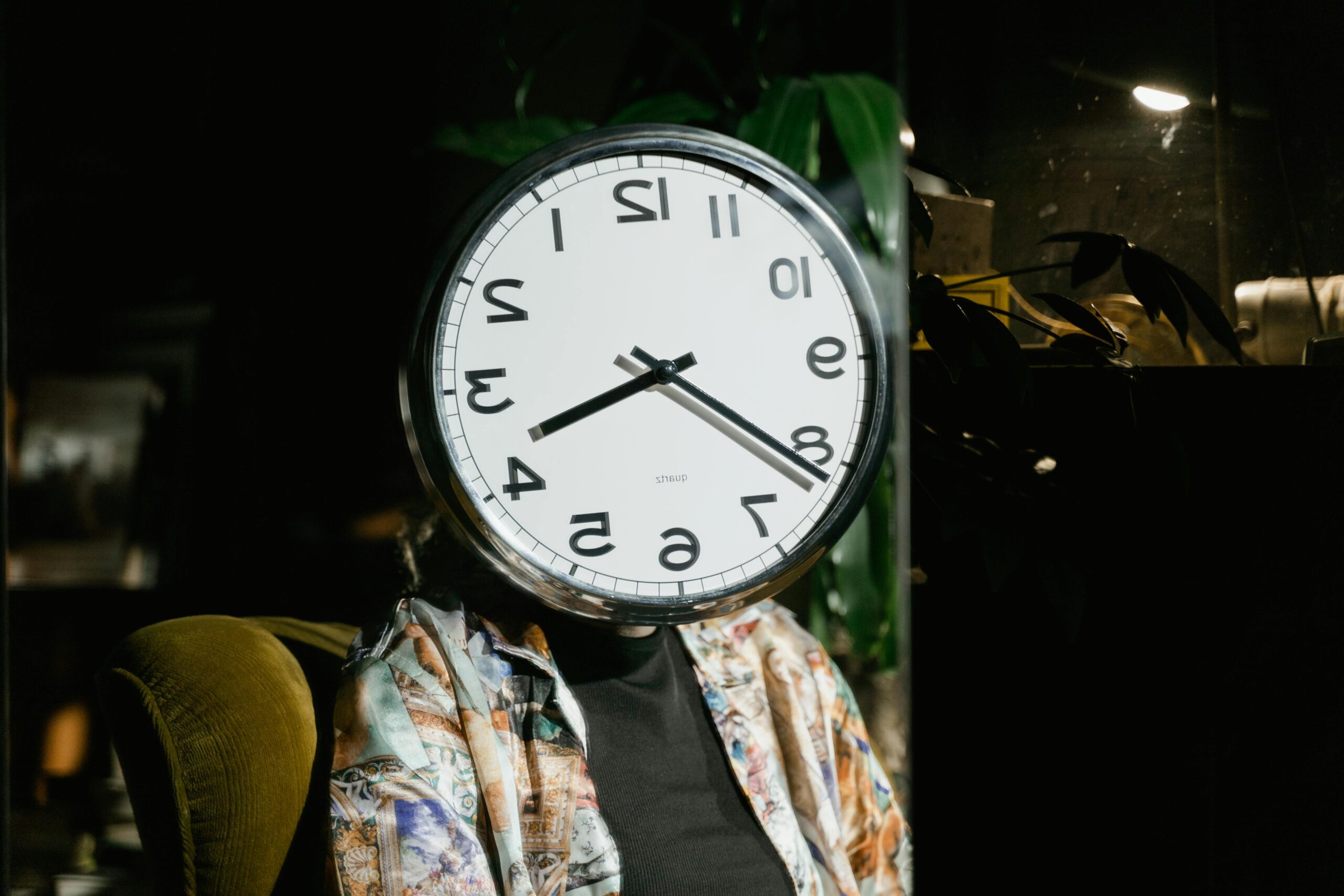
Embracing the Paradox
Perhaps the appropriate response to understanding time’s illusory nature isn’t to dismiss temporal experience but to hold it more lightly. We can engage with conventional time for practical purposes while recognizing its constructed nature. We can plan for the future while knowing that future is a mental construction. We can learn from the past while understanding memory is continually being reconstructed in the present.
This paradoxical stance—fully engaging with time while recognizing its illusory quality—mirrors the Buddhist concept of living in the world while not being of it. It allows for effective functioning within temporal structures without being imprisoned by them.
The fragile illusion of time, once recognized as illusion, doesn’t disappear. The magic trick continues even after you know how it’s performed. But knowing changes your relationship to it. You’re no longer quite so fooled, quite so controlled by the relentless ticking clock.
In the end, the mystery of time reflects back the mystery of existence itself. That anything exists at all, that consciousness arises to contemplate its own nature, that we can question the very framework within which questions occur—these remain the deepest wonders. Time, in all its paradoxical nature, stands as a reminder that reality exceeds our conceptual grasp, inviting us into ever-deeper inquiry into the nature of what is.
Living with this awareness doesn’t provide easy answers but opens space for more authentic engagement with each moment. When we recognize that time is less like a river carrying us along and more like a construction of consciousness, we discover unexpected freedom. The present moment, this eternal now that never arrives and never leaves, becomes both the question and the answer, the mystery and its resolution.
